

A dining table is no longer judged only by how many people it seats. Buyers also care about walking paths, chair movement, visual identity, cleaning time, and how well the table handles daily use. In hotels, restaurants, villas, and high-end apartments, four separate legs can make a large table feel heavier and more crowded than it really is. A sculptural pedestal base combines support and decoration in one central form. Still, an attractive shape is not enough. You need stable engineering, suitable materials, accurate production, safe packing, and service after delivery.
Why Are Traditional Four-Leg Tables Losing Ground?
Four-leg tables remain useful for simple residential ranges. Problems appear when a project needs flexible seating or a stronger visual centerpiece. Corner legs can restrict chairs and add floor-level obstacles.
More Seating Freedom Around the Edge
A pedestal base removes most corner-leg interference. Chairs can move slightly left or right without hitting a leg, which helps when a restaurant uses different chair widths or when a family adds an extra place setting.
This matters on tables around two meters long. A centered support keeps the outer edge open and gives designers more control over chair spacing.
A Focal Point Without Extra Decoration
Curved tubes, crossed forms, polished metal, and controlled asymmetry can give the dining area character without extra decorative objects. The table does the visual work, which can save a surprising amount of styling effort.
PNA Furniture has produced modern furniture since 2010 for residential and hospitality projects. Its manufacturing scope covers metal, wood, marble, panel, fabric, and upholstery, with design, engineering, production, and quality control handled as one process.
What Makes a Pedestal Dining Table Stable Enough?
A pedestal design places more load on fewer support points. Shape alone cannot prove stability. You should check the base footprint, tabletop weight, connection plate, tube thickness, weld quality, and the table’s response when pressure is applied near an edge.
Stability Starts with the Technical Drawing
A well-planned base spreads weight toward several floor contact points. The fixing plate below the top also needs enough surface area.
Before approving an order, ask for:
- Overall base width and floor contact points
- Top-to-base fixing positions
- Recommended maximum tabletop size
- Net weight and gross weight
- Assembly hardware details
- Stability or anti-tip test method
- Spare-part availability
Small geometry changes can affect the result. Even screw direction matters when installers have little access beneath a heavy stone top.
Metalwork Quality Matters More Than a Fancy Shape
Stainless steel tubes should be cut at accurate angles, held in dedicated fixtures, welded cleanly, and polished until the seams are flat. PNA Furniture’s documented process includes automatic laser tube cutting, CNC sheet cutting, dedicated jigs, hand welding, grinding, and mirror-level polishing. More than 1,000 stored jig sets help keep repeated orders consistent.
For painted iron parts, the process includes anti-rust treatment, primer, low-temperature baking at 45 to 50°C for about two hours, manual finishing, and natural drying. Skilled manual work is slow, but it helps a refined base avoid the look of a quickly assembled frame.
Which Materials Work Best for Sculptural Dining Tables?
Material choice should follow the sales setting. Private dining rooms may value visual depth, while restaurants need easy cleaning and repeatable finishes.
Stone Tops Combine Visual Weight with Daily Practicality
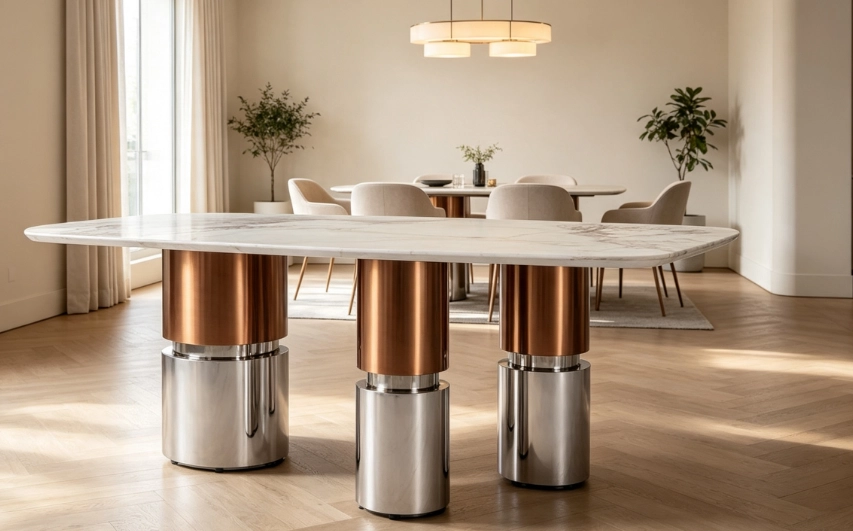
The Marble Dinning Table PADT216A is one example. It pairs a 3D-printed microcrystalline stone top with a polished stainless steel pedestal base. The table measures 2000 × 1000 × 750 mm. Its surface is designed to provide a natural-stone look with scratch, heat, and everyday-use resistance, while white or matte black top options can be paired with silver or gold-toned base finishes.
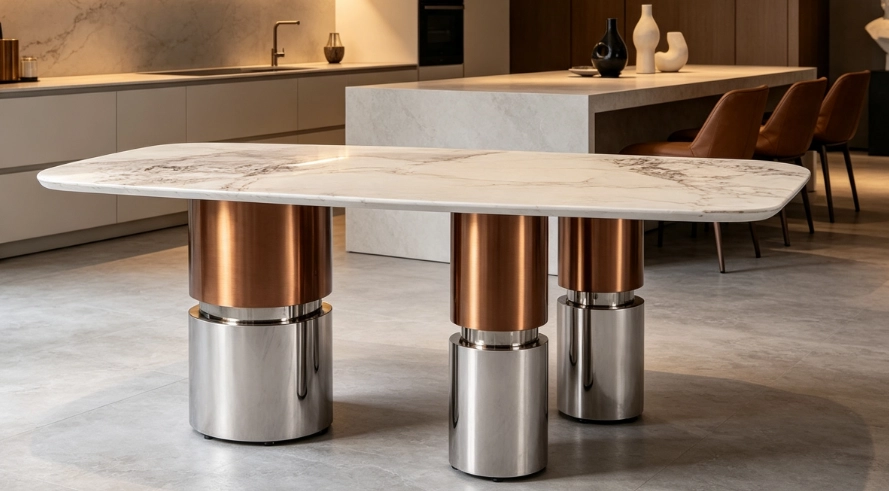
You should still confirm edge treatment, pattern consistency, crate design, and replacement-top availability.
Stainless Steel Works Well for High-Visibility Bases
Polished stainless steel reflects light, resists corrosion, and is easy to wipe. Brushed finishes hide small marks better. Mirror finishes look more dramatic, though fingerprints become part of daily cleaning. No glamorous sales photo mentions that bit.
Always request a physical finish sample before bulk production. Screen colors are not reliable enough for champagne gold, bronze, brushed gold, or highly reflective silver.
What Should B2B Buyers Check Before Ordering?
Sourcing is about risk control. A low unit price loses its appeal when an unstable sample, mismatched finish, or damaged top delays a hotel opening.
Check Layout, Maintenance, and Packing Together
Measure more than the tabletop. Chairs need pull-out space, staff need service routes, and a low, wide base may reduce foot room.
Your pre-order checklist should cover:
- Dimensions, tolerance, materials, and finish codes
- Approved CAD or 3D drawings
- Chair clearance and base footprint
- Separate packing for the top and base
- Crate protection for stone edges
- Assembly instructions and tool
- Pre-shipment inspection records
- Warranty terms and replacement procedure
The PNA Furniture project cases are useful for checking whether production experience extends beyond showroom samples. Its company profile lists one-to-one design support, digital previews, custom development, door-to-door logistics, and an 18-month warranty. The supplied knowledge base also notes factory-direct service and flexible quantities for retailers, wholesalers, hospitality buyers, and custom projects.
Use the Right Production Base for the Order
PNA Furniture uses its China facility for R&D, custom development, prototypes, and complex multi-material work. Its Vietnam production line, launched in June 2025, focuses more on standardized production and overseas order delivery. It can accept dozens of pieces per model rather than forcing every buyer into a full-container minimum.
The company-provided production brief states that labor costs for key roles in Vietnam can be around 60% to 70% of those in eastern coastal China. It also estimates that suitable North American and European orders may reduce customs duty costs by 20% to 25%. These figures are not automatic. Savings depend on the HS code, origin rules, destination, and current tariff policy, so your customs broker should check the route before the contract is signed.
The Vietnam line follows the headquarters’ design, equipment, inspection, and environmental standards. Buyers dealing with tariff pressure can request a China-versus-Vietnam comparison through the contact page.
FAQ
Q1: Are Pedestal Dining Tables Less Stable Than Four-Leg Tables?
A: Not necessarily. Stability depends on the footprint, weight distribution, fixing plate, material thickness, and connection design. A properly engineered pedestal base can safely support a large stone top.
Q2: Which Tabletop Material Works Well for Hotels and Restaurants?
A: Microcrystalline stone is practical because it offers a stone-like appearance, scratch and heat resistance, and easier daily care. You should still check edge strength and replacement availability.
Q3: Can Sculptural Dining Tables Be Customized for a Project?
A: Yes. PNA Furniture supports OEM and ODM changes to size, top material, color, base finish, and packaging. Approve the technical drawing and finish sample before production.
Q4: Is a Pedestal Table Easier to Clean?
A: Usually, yes. Fewer legs create fewer floor-level corners and obstacles. A very wide sculptural base may still require manual cleaning around its curved sections.
Q5: Can Orders Be Produced in Vietnam to Lower Tariffs?
A: Yes, selected standardized orders can be assigned to PNA Furniture’s Vietnam production line. Final duty benefits vary by destination and origin rules, so confirm the tariff treatment before ordering.


