

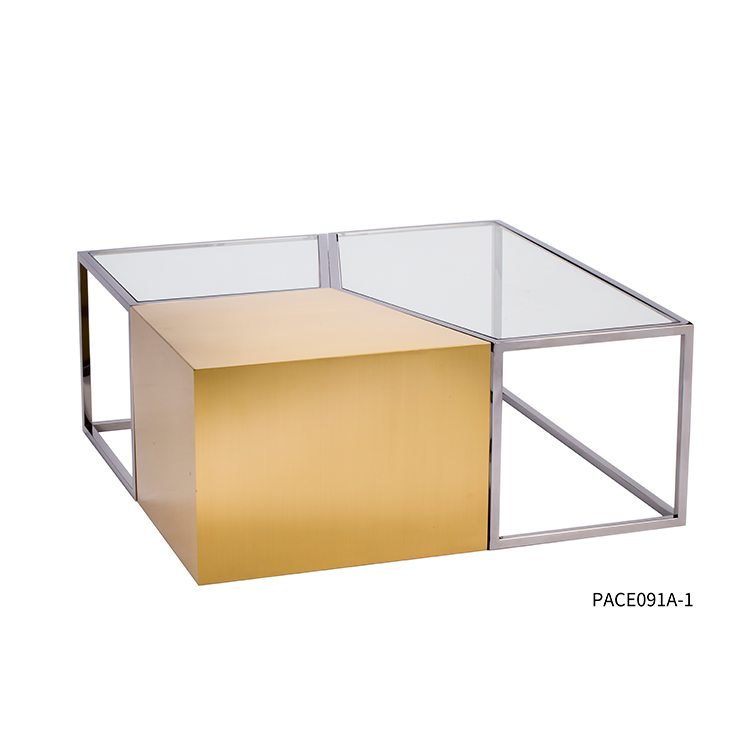
At first glance, a side table appears to be a rather minor item. Even the most exquisite luxury living room can be easily overpowered by an uncoordinated side table. Yet, as an importer, an interior designer, a project buyer or a retailer, you are not solely concerned with the aesthetics of this seemingly insignificant item. Above all, the choice of side table is subject to a multitude of factors including size, material, height, packing density, surface finish and durability of the finish. Only if these criteria are fulfilled to the required extent, the side table will also develop its full visual potential once put to practical use. If not, it can easily become a problem in the living room and obstruct a path, be too low next to a sofa, scratch too quickly or simply give the luxurious room a somewhat inferior look. Although these issues are not dramatic in themselves, they are always noticed by the buyer.
A good side table should hold daily items, match the sofa or lounge chair, add a material accent, and take very little floor space. That sounds simple. In real sourcing, it is where many small mistakes happen.
Why Does Side Table Size Matter More Than Buyers Expect
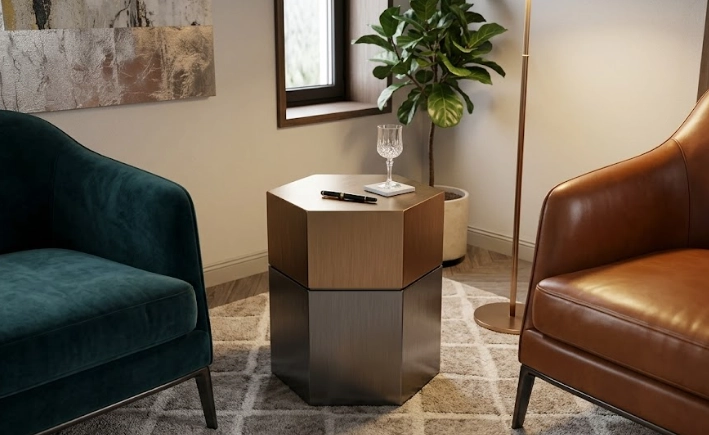
Size is the first filter. Before talking about marble, metal or glass, the table has to fit the room and the furniture around it. Luxury does not always mean bigger. In many apartments, hotel suites, villas and lounge areas, a compact side table often performs better than a bulky one.
Match Height to Seating Not to Catalog Looks
A side table usually works best when its top sits close to the sofa arm or chair arm. For many living room settings, a height around 500 to 570 mm is practical. Lower lounge sofas may work better with 480 to 520 mm. Taller hotel chairs or deep lounge seating may need about 550 to 610 mm.
The easy rule is this: the user should reach the tabletop without raising the shoulder. If the table is too low, it feels decorative but not useful. If it is too high, it looks awkward beside a sofa. This is a small detail, but in luxury furniture, small details are often what clients complain about first.
Keep the Footprint Tight but Still Useful
For compact luxury living rooms, side tables with a diameter around 350 to 450 mm are often easier to place. Square or rectangular models around 300 to 500 mm can also work well beside a sofa, beside an accent chair, or near a reading corner.
A tiny table should not become useless, though. It still needs space for a cup, remote, phone, small lamp, or decor item. For commercial projects, it also needs to survive cleaning staff, guest movement and frequent repositioning. So, do not only chase the smallest size. Choose the smallest size that still works.
Which Shape Saves More Space Round Square or Nesting
Shape changes both the look and the traffic flow. A side table may have the same width on paper, yet feel very different in the room. Buyers often forget this when comparing supplier quotes, because spec sheets only show numbers. The room does not read numbers. It reads edges, lines and empty space.
Round Tables Cut Visual Weight
Round side tables are popular in luxury living rooms because they soften straight sofa lines and reduce sharp corners. A 400 mm round table can feel lighter than a 400 mm square table, even when the footprint is close.
Round models are also safer in tight areas. For hotel rooms, serviced apartments and show flats, this matters. People move bags, push chairs, or walk around beds and sofas. A round edge is simply easier to live with.
Rectangular Tables Work Better Beside Walls
A rectangular side table is better when the room has a clear wall line or a narrow sofa gap. It can sit beside a sofa arm without wasting back space. Slim models, such as 300 mm wide or 350 mm wide tables, are useful for tight corners where a round table would push too far into the walkway.
Nesting tables are another good option. They let the user pull out extra tabletop space only when needed. For small luxury rooms, that is a very practical trick. It does not feel like a trick, which is why it works.
Which Side Table Material Fits Luxury Living Rooms Best
Material is where the buyer’s concern becomes more direct. The table needs to look expensive, but it also has to ship safely, clean easily and match the order budget. Natural stone, artificial marble, ceramic, glass, veneer and metal all have their place. None of them is perfect for every project.
Natural Marble Feels Premium but Needs Smart Placement
Natural marble side tables are strong in visual value. A small stone table can act like a statement piece without taking much floor area. Materials such as travertine, green stone, brown marble, red travertine and black-veined marble are often used in luxury living rooms because each piece has natural texture.
The trade-off is weight and stone variation. For high-end residential buyers, that variation is usually a benefit. For chain projects, it needs clear approval before mass production. A good supplier should confirm the stone type, thickness, edge treatment, packing method and color range before production starts.
Metal Glass and Veneer Give Different Benefits
Metal brings structure. Glass brings lightness. Veneer brings warmth. Ceramic and artificial marble offer stable looks with easier batch control. The right answer depends on how the room will be used.
For example, the Side table range from PNA Furniture includes compact models using marble, ceramic, glass, metal, veneer and artificial marble finishes. The product point is simple: choose stone for a strong luxury accent, metal for structure, ceramic for easier care, and veneer when the room needs a softer tone.
How Can Craftsmanship Stop a Small Table From Looking Cheap
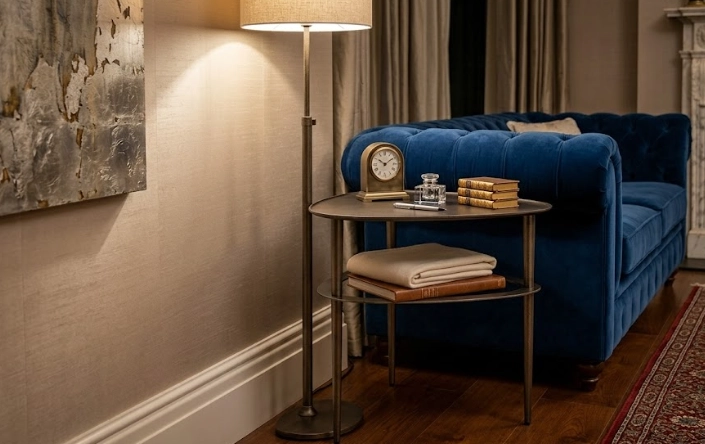
A side table is small, so rough details are easier to notice. Bad welding, uneven polishing, poor coating, weak joints, and unstable bases can ruin the whole feel. In a showroom, clients may touch the edge, check the reflection, or move the table a little. A shaky table loses trust very fast.
Check Welds Polishing and Coating Before Price
For metal side tables, welding and polishing are not just factory steps. They decide the final look. PNA Furniture uses stainless steel and iron processes, including thick-walled tubes, smooth welding, mirror-like polishing, automatic laser tube cutting and CNC cutting for metal sheet parts.
Jigs also matter. A dedicated jig keeps tubes in the right position during welding, so repeated orders stay consistent. After welding, the grinding step removes weld marks before painting. Some factories skip it because it takes time. But without smooth grinding, the coating surface will not look clean.
For iron frames, anti-rust treatment, primer coating and slow baking at about 45 to 50 degrees Celsius help the finish gain hardness without becoming brittle. Manual finish painting can create different textures and surface effects. That is the kind of factory detail buyers should ask about. Not fancy wording. Real process.
Ask for Real QC Points Not Just General Promises
Quality control should be specific. For side tables, useful inspection points include:
- Color and finish match the approved sample
- Total size is measured before packing
- Surface has no obvious scratches
- Welding joints have no visible dents
- Base stands flat and stable
- Marble, ceramic or glass top is packed safely
- Carton volume matches the shipping plan
PNA Furniture states an 18-month quality warranty and full-process inspection support. For B2B buyers, this matters because one small table defect can become a costly after-sales issue when shipped across borders.
How Should B2B Buyers Plan Orders Without Wasting Budget
A perfect side table is not only a design choice. It is also a sourcing choice. Retail buyers care about test orders. Designers care about customization. Hotel and villa projects care about batch consistency. Importers care about duties, lead time and packing volume. These concerns are very normal, and a good sourcing plan should answer them early.
Start With a Small Batch Before Filling a Container
Small batch flexibility is useful for side tables because designs vary a lot. One market may like round marble. Another may prefer metal and glass. A retailer may need several styles before knowing which one sells.
PNA Furniture supports flexible order models, including low MOQ or no MOQ options on suitable programs, plus free design adjustment and custom drawing support. For buyers who want to test several side table models, this reduces the pressure of committing to a full container too early.
You can also check project cases to see how different furniture categories are used across real applications. It is a better habit than judging only by one catalog page.
Use Dual Production Lines for Tariff and Delivery Planning
For custom and development work, the China factory focuses on R&D, 3D prototyping, customization and multi-material production. This is useful when a buyer needs a new side table collection, special size, new finish, or project-based design.
For standardized production and overseas order delivery, the Vietnam production line gives another option. According to PNA Furniture’s factory information, the Vietnam facility can help reduce tariff pressure for some North American and European orders, with possible customs duty savings around 20% to 25%, depending on destination rules, product classification and order details. It also supports flexible low MOQ instead of only full-container orders.
This dual-base setup is worth asking about when you compare quotes. A cheaper unit price may not be the best deal if duty, logistics time and order flexibility are poor. For some buyers, Vietnam production can lower the landed cost. That is the number that really matters.
What Should Be Checked Before Sending an Inquiry
A clear inquiry saves time. Vague requests create long email chains, wrong samples and slow quotes. For side tables, buyers do not need a long document, but the key details should be ready before contacting a supplier.
Send Clear Sizing and Room Use Details
Before asking for price, prepare these points:
- Target size, such as diameter 400 mm and height 550 mm
- Shape preference, such as round, square, C-shaped or nesting
- Material choice, such as natural marble, ceramic, glass, metal or veneer
- Finish requirement, such as brushed metal, polished steel or black powder coating
- Use case, such as retail, villa, hotel room or apartment project
- Expected order quantity
- Destination country and preferred trade term
- Packing requirement if the project has strict carton limits
This makes the supplier’s reply much more useful. PNA Furniture provides factory-direct service, custom furniture support and global delivery options through PNA Furniture, so a detailed inquiry helps the team match the right production route faster.
Check Support After Shipment
Side tables are small, but after-sales support still matters. A cracked stone top, scratched metal frame, missing foot pad or unstable base can delay a whole project room. Ask the supplier how defects are handled, whether spare parts are available, and how fast the sales team replies.
PNA Furniture offers an 18-month quality guarantee and supports free replacements for manufacturing defects under normal use conditions. Buyers can also reach the team through the contact page for project discussion, catalog requests or custom side table development.
FAQ
Q1: What Is the Best Height for a Luxury Living Room Side Table?
A: A practical side table height is usually around 500 to 570 mm. The best choice depends on the sofa or chair arm height. The tabletop should sit close to the arm level, so daily use feels natural.
Q2: Is a Round Side Table Better for Small Living Rooms?
A: Yes, in many cases. A round side table has no sharp corners and feels lighter in tight spaces. It is especially useful beside lounge chairs, curved sofas and compact hotel rooms.
Q3: Which Material Looks Most Luxury for a Side Table?
A: Natural marble gives the strongest luxury feel, while ceramic, artificial marble, glass, metal and veneer are easier to control for batch orders. For commercial projects, material stability and cleaning should matter as much as appearance.


