


Key takeaway: A packing release should identify the accepted sample and quantity. Open corrections remain on hold. The receiver needs the approved record to compare with the delivery.
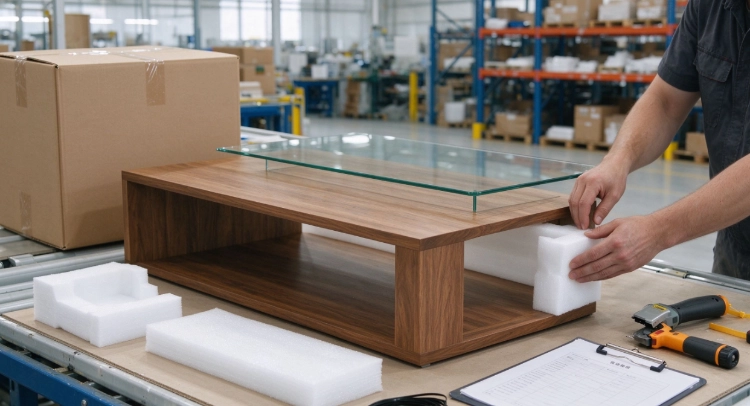
A closed-carton photograph cannot show where fittings sit or whether dividers moved. For coffee table export packing, review an open sample with the assembly drawing. It gives the buyer a way to count the parts and examine their protection before approving the arrangement.
Confirm the table before calculating the shipment
The PACE004A-1 coffee table is 1,050 mm in diameter, with a height of 400 mm. Top choices are white marble and black marble, or clear and black glass, both 12 mm thick. Its frame-only packing reference specifies two cartons per frame set and a volume of 0.48 CBM.
The top packing remains unconfirmed. Ask whether the selected top is included in the quotation and how it will travel. Complete-table carton counts and volumes require separate confirmation; 0.48 CBM applies only to the frame reference.
Read carton counts and volume separately
Using that frame-only reference gives these preliminary quantities:
|
Frame sets |
Frame-reference cartons |
Frame-reference volume at 0.48 CBM per set |
|
10 |
20 |
4.8 m³ |
|
20 |
40 |
9.6 m³ |
|
30 |
60 |
14.4 m³ |
These are frame quantities only. A complete-table loading plan must account for top packing, reinforcement and pallets, with actual carton dimensions, gross weights and stacking restrictions.
The PACE001A-1 coffee table provides a useful comparison. It is 1,080 mm in diameter and 430 mm high. Its frame-only packing reference is two cartons per frame set and 0.53 CBM. Its top options are white marble, black marble, 12 mm clear glass and 12 mm black glass.
Twenty frame sets give nominal volumes of 10.6 m³ and 9.6 m³ respectively, despite both references yielding forty cartons. Neither figure includes a confirmed top package. The supplier must confirm that separately before calculating complete-table shipment quantities.
Check the open package and the packing sequence
With the drawing beside the sample, the reviewer can identify the larger parts, then account for brackets, pads and fittings. Each has to arrive without rubbing against a surface it could mark. The assembly instructions also need an obvious place in the carton.
Have the sample packed again during the review. A divider that shifts as the next part goes in needs correcting in the sequence itself. When the arrangement works, record three views: the identified table before wrapping, the open package and the closed, labelled carton.
Preserve the condition accepted at inspection
PNA inspects every product before shipment. Inspectors compare the color and finish with the customer’s order and measure the overall dimensions. They check the surface for cleanliness and obvious scratches, then inspect the welds, where scars and dents are not permitted.
A product inspection establishes the condition before wrapping. Packing approval is a separate decision about protection, and a required transport test needs its own report. Passing one does not establish that the others have been completed. Any repaired part needs checking again before it is wrapped, with the result retained in the inspection record.
The finish is then in contact with its wrapper for the journey. Dirty material can mark it; a coating covered too soon can retain an impression. The factory needs to specify a suitable wrapping material and when it can be applied. Any deadline for removing it must reach the receiving team.
Give every failed check a decision and an owner
For a custom order at PNA, design consultation can begin with the customer’s ideas or sketches from the Italian team. The drawings and quotation are finalized before production starts on a 30% deposit. There are progress updates during production; pre-shipment inspection comes before balance payment and logistics. The buyer can use the approved drawing to identify any later change that affects the packing.
The inspection can refer to the agreed contents list and finish specification. That ties a finding to an order requirement and gives the approver a basis for a decision. The responses below are recommendations for the buyer’s procedure.
|
Observation |
Initial decision |
Evidence needed before release |
|
Missing fitting against the agreed contents list |
Hold the incomplete set |
Add the fitting and record a full recount |
|
Top or finish does not match the order |
Separate the affected set and hold it |
Agree the remedy, then inspect the corrected or replacement part |
|
Divider moves, allowing hard parts to touch |
Hold approval of this arrangement |
Adjust the support, repeat the packing and reopen the sample to check it |
|
Label leaves the variant or contents unclear |
Correct the label before release |
Compare the replacement label with the order and the contents inside |
Close corrections before signing the release
An open item stays with its named owner until the correction has been checked. For missing hardware, that means adding the fittings and recounting them, then recording the result. A promise to do it later is not enough for the person authorizing dispatch.
The same person needs to know how many sets the approval covers. If a divider failed in the sample, are other cartons made to that arrangement affected? The buyer and factory must agree the extent of the recheck. A repaired sample should not quietly become approval for an entire unchecked shipment.
An order requiring a transport test needs an agreed protocol, sample configuration and pass criteria. The International Safe Transit Association’s 2C overview addresses packaged furniture case goods. A qualified testing party can assess whether it applies here. The approval record would need the actual report tied to the packing version tested.
Make the approved record usable at the receiving dock
The person unpacking the order may never have seen the chosen table. A useful carton label supplies the order number, model, top or finish, contents and carton sequence. Spare tops and other extras belong on separate lines from complete-table sets.
An order mixing models from the coffee table collection needs a distinct packing-list entry for each option. Product choices are covered in the guide to customizing coffee tables for different interior projects. The drawing and packing revision should identify the final selection.
Compare arrival with the released configuration
Start with the boxes still closed: count and identify them, and photograph visible damage. During unpacking, compare the protection with the sample record and note the contents and their condition. Doing this before assembly helps keep the arrival evidence separate from anything that happens during installation.
A difference needs a precise description. “Divider missing between the base parts” is more useful than “poor packing,” particularly with a photograph and the relevant carton label. The affected set can then be held for review with its packaging. Referencing the released drawing and packing revision gives the supplier the same starting point as the receiver.
Keep manufacturing defects and handling damage distinct
Confirm the warranty period on the order. PNA’s 18-month quality-warranty terms provide replacement without charge for manufacturing defects under normal use conditions, excluding damage from improper handling. They also include a full-refund option for a customer unsatisfied with the resolution and direct customers to their sales representative for assistance.
For a scratch reported on arrival, compare the factory and unpacking photographs. The mark may already be visible before wrapping, or appear for the first time at receipt. Keeping both sets of images under the same carton identity helps the supplier investigate. The reporting arrangements should be agreed with the order.
Request packing details with the order inquiry
FOB, CIF and door-to-door shipping are available from PNA Furniture. Send the model, top choice, quantity and intended route when requesting packing details. The quotation should identify the chosen service and delivery arrangements.
Three points need a clear answer before approval:
- What is inside each carton, including the selected top and every fitting?
- What are the final dimensions, gross weights and protection for the complete order?
- Who accepts corrections, and which packing revision will the receiving team use?
Once corrections are accepted, record the quantity released. Send the receiving team the dated approval and its packing revision before dispatch. They will then have a specific arrangement to check when the cartons arrive.


